

If your safe has Fichet or Bauche on the plate, it belongs to the story of France’s best-known safe maker. Until 1967, though, that maker was two rival firms: Fichet, a Paris locksmith founded in 1825, and Bauche, a fire-safe maker from near Reims. Here’s the real history of both, and how to tell which one made yours.
1825
Alexandre Fichet opens his Paris locksmith’s shop
1864
Bauche starts making safes at Gueux, near Reims
1967
Fichet and Bauche merge
7,800
safes in the Crédit Lyonnais vault in Paris
Key takeaways
- Fichet-Bauche is French. Fichet began as a Paris locksmith in 1825; Bauche as a fire-safe maker at Gueux in 1864.
- The two companies merged in 1967, not 1879 as some histories (including an earlier version of this article) say.
- Gunnebo owned Fichet-Bauche from 1999 to 2018; since then it has belonged to OpenGate Capital as part of the Fichet group.
- A plate reading “Fichet” or “Bauche” alone usually means a safe from before 1967; “Fichet-Bauche” means 1967 or later.
- Fichet door locks (Point Fort Fichet) are a separate business, owned by Assa Abloy, from Fichet-Bauche safes.
In This Article

Fichet-Bauche at a glance
| Country | France |
| Fichet | Founded 1825 in Paris by Alexandre Fichet (1799–1862), locksmith |
| Bauche | Founded 1864 at Gueux, near Reims, by a Bauche who owned a firebrick works (named Auguste-Nicolas or Henri in different company sources) |
| Merger | 1967, as Fichet-Bauche |
| Known for | Pick-resistant locks, bank strongrooms and safe deposits, fire safes, the Bauche “Cuirassé” |
| Owners | Gunnebo (1999–2018); OpenGate Capital, as Fichet Security Solutions / Fichet group (from 2018) |
| Factories | Paris, Lyon and Marseille (Fichet); Gueux and Reims (Bauche); Sens (Fichet, 1917); Bazancourt (after the merger) |
Fichet: the Paris locksmith
The Fichet half of the name starts with a locksmith. Alexandre Fichet was born at Étrépilly, Seine-et-Marne, in February 1799 and opened his own workshop in Paris in 1825.1 On 29 March 1829 he patented a lock designed to be impossible to pick, with moving pistons and a relocking device.2 He became locksmith to the Bibliothèque royale, and in 1846 patented a “system of invisible combinations” for locks of every kind.1
In 1840 he built his first modern fire-resisting safe: double steel walls and a Fichet key lock. Demand led to factories in Lyon and Marseille.3 Fichet died in August 1862 and his daughter Apolline succeeded him; the business then changed hands several times.13


The Musée des Arts et Métiers in Paris shows a Fichet safe lock “à quatre combinaisons invisibles”, engraved as a gift from the inventor. Its plate describes Fichet as “breveté” (patentee) and supplier to Emperor Napoleon III, the Empress and Prince Napoléon, which places it in the Second Empire (1852–1870).4
Fichet’s name was famous enough for Jules Verne to mention his invention in two novels, César Cascabel and Claudius Bombarnac.1 Not many lock makers can say that. For the wider story of how keyless combination locks developed, see our history of safe lock mechanisms.
Bank strongrooms and safe deposits
In 1879 Fichet built its first bank strongroom with safe deposit lockers for rent. In 1917 it opened another factory in Sens, and two years later branches in Italy, Argentina, Spain, Belgium, Romania and Brazil. In 1926 it set up its first industrial alarm and surveillance network.3
The best-known Fichet installation is the vault under the Crédit Lyonnais headquarters on the Boulevard des Italiens in Paris, begun in 1876. Over four basement levels it held some 7,800 Fichet safes for private customers, and securities were kept in 195 further Fichet safes.5 When fire wrecked the building on 5 May 1996, the vault was described as the largest in Europe. Part of the building collapsed on top of it, but only two strong cupboards were reported damaged, and only on the outside, by a falling beam.6 It belongs with the other great European bank vaults, such as the Bank of Spain’s gold vault in Madrid.
Bauche: fire safes from Champagne
The other half of the name came from bricks rather than locks. In 1864 a Bauche who owned a firebrick works began making safes at Gueux, near Reims. Even the company can’t settle on his first name: its archived history calls him Auguste-Nicolas Bauche, its current website Henri. His safes used two seamless iron boxes with refractory material packed between them.32 It was the same idea as the British fire-resisting safes described in our article on the invention of the fireproof safe.
Bauche sold its safes with demonstrations. In 1879 it locked the equivalent of 100,000 francs inside one safe and put it through fire repeatedly; the banknotes came out intact. In 1895 it launched a fire-resisting, armour-plated safe that became a great success.3 Bauche marketed it as “Le Cuirassé” (the ironclad), and by 1904 its posters claimed Bauche supplied government ministries, the Banque de France, the Société Générale, the Comptoir National d’Escompte and the Crédit Lyonnais.7

Timeline
- 1825 Alexandre Fichet opens a locksmith’s workshop in Paris.
- 1829 Fichet patents a pick-resistant lock.
- 1840 First Fichet fire-resisting safe.
- 1862 Fichet dies; his daughter Apolline takes over.
- 1864 Bauche starts making safes at Gueux.
- 1879 Fichet’s first bank strongroom with rentable lockers; Bauche’s 100,000-franc fire test.
- 1895 Bauche’s armour-plated fire safe.
- 1967 Fichet and Bauche merge.
- 1999 Gunnebo buys Fichet-Bauche.
- 2018 Gunnebo sells its French business to OpenGate Capital.
The 1967 merger, Gunnebo and the Fichet group
The old rivals finally merged in 1967 and moved production to a single factory in the Reims area. The company says Reims; other sources say Bazancourt, about 15 km away.28 In December 1999 Fichet-Bauche joined the Swedish Gunnebo group.8 In 2000 Gunnebo also bought Chubb’s safe business, so by then Gunnebo owned Fichet-Bauche alongside the British names Chubb and Tann.9
In 2018 Gunnebo sold its businesses in France, Belgium and Luxembourg, including the Bazancourt and Baldenheim factories, to the private equity firm OpenGate Capital.10 OpenGate renamed the business Fichet Security Solutions and described Fichet Bauche as “a well-established brand for high quality safes and vaults”.11 Fichet-Bauche is now part of the Fichet group, with its head office at Vélizy-Villacoublay.8
Did you know?
Fichet safes and Fichet door locks are now different companies. The high-security door lock business trades as Point Fort Fichet and belongs to Assa Abloy, while Fichet-Bauche safes belong to the Fichet group.12 If you need a key for a Fichet front door, Fichet-Bauche is the wrong place to ask.
How to identify a Fichet or Bauche safe
French safe makers didn’t publish serial registers, so you’ll have to date yours from what’s on it: the name, the wording and the lock. These clues follow from the company dates above:
Before 1967
“Fichet” or “Bauche”
A plate with only one of the two names comes from the separate companies, before the 1967 merger. “Le Cuirassé” points to a Bauche safe of 1895 or later.7
Wording
Imperial suppliers
“Fournisseur de S.M. l’Empereur” (supplier to His Majesty the Emperor) on a Fichet lock or plate means the Second Empire, 1852–1870.4
1967 onwards
“Fichet-Bauche”
The joint name means 1967 or later. A Gunnebo label alongside it suggests 1999–2018; an A2P certification label means a modern, insurer-rated safe.8
Fichet safe locks: M3b and MXb
Fichet’s modern safe locks are distinctive. The M3b is a lever safe lock, and you’ll recognise it by its key, which is unusually round and toothed.12 The MXb-C is Fichet-Bauche’s mechanical key safe lock certified by the French testing body CNPP: its A2P certificate, CM 8.67, places it in class C and dates from 2001.13 A2P is the French insurers’ certification mark for safes and locks.
If your Fichet-Bauche safe is locked and you’ve lost the key or code, contact Fichet’s service department or a qualified safe engineer. Expect to prove that the safe is yours: no reputable engineer opens a safe without that.

Myths and unverified claims
Fichet merged with Bauche in 1879.
The merger was in 1967. In 1879 the two firms were still rivals.
Fichet-Bauche bought Chubbsafes in 2000.
Gunnebo, Fichet-Bauche’s then owner, bought Chubb’s safe business.
Fichet-Bauche is still part of Gunnebo.
Gunnebo sold it to OpenGate Capital in 2018.
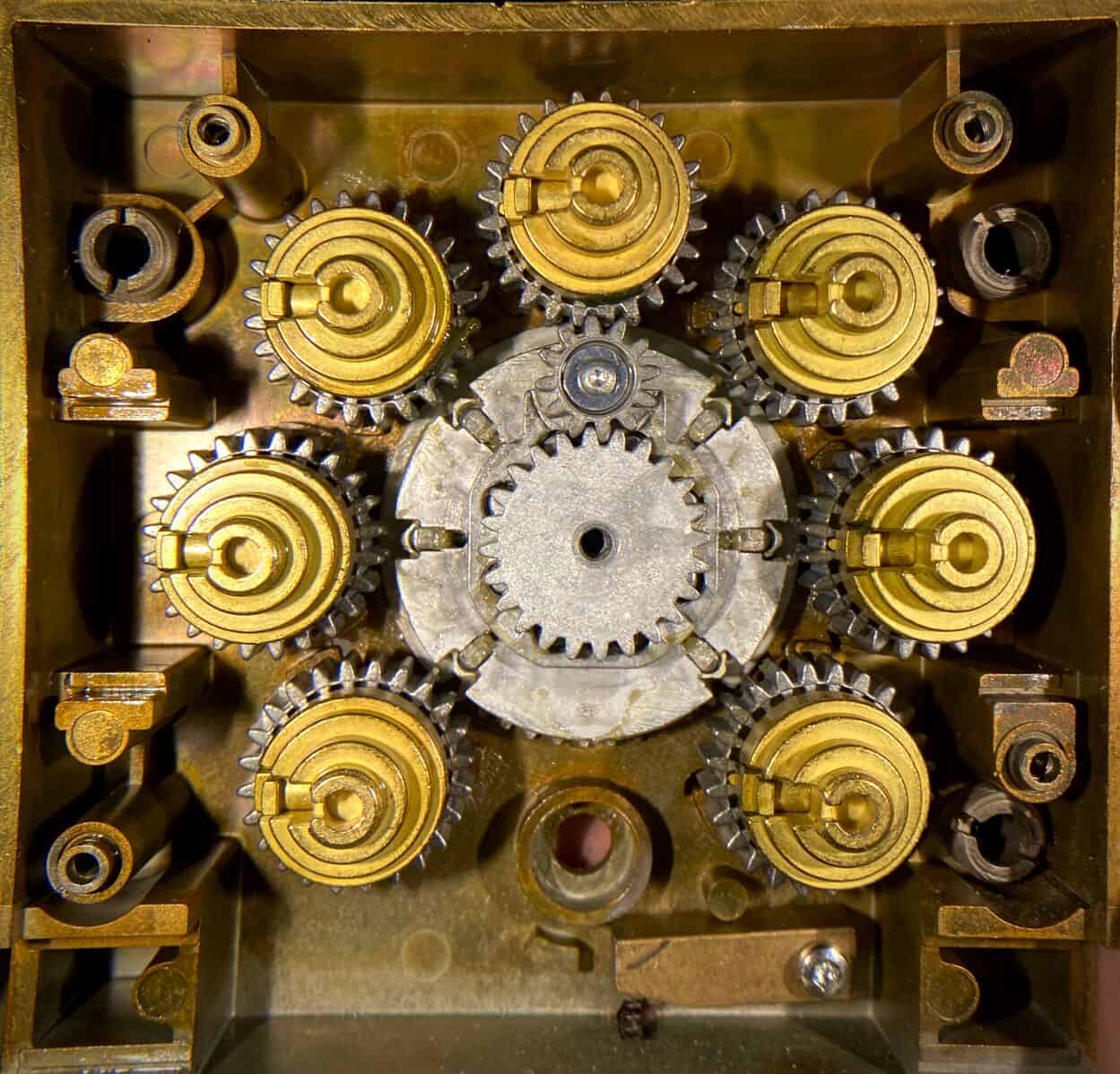
The “Monéo” is a biometric safe.
The Moneo is a Fichet lock with a gear-wheel mechanism, as the photo above shows.
Adverts in the collection


Frequently asked questions
What country is Fichet-Bauche from?
France. Fichet was founded in Paris in 1825 and Bauche near Reims in 1864; the merged company is based at Vélizy-Villacoublay, near Paris.
Who was Alexandre Fichet?
A Paris locksmith (1799–1862) who opened his workshop in 1825, patented a pick-resistant lock in 1829 and built his first fire-resisting safe in 1840.
Is Fichet-Bauche part of Gunnebo?
Not any more. Gunnebo owned it from 1999 to 2018, then sold its French business to OpenGate Capital, which formed the Fichet group.
How do I open a Fichet-Bauche safe without the key?
Contact Fichet’s service department or a qualified safe engineer, and have proof of ownership ready. Don’t force the door: that usually destroys the lock and the safe’s certification.
How old is my Fichet safe?
Start with the name on the plate. “Fichet” alone means before 1967, “Fichet-Bauche” 1967 or later. Wording such as “fournisseur de l’Empereur” points to 1852–1870.
Own a Fichet or Bauche safe and want to know how old it is? Send us photos of its plate, lock and serial number and we’ll help you identify and date it.
Sources:
- Wikipédia (French), “Alexandre Fichet”, citing J. Lambert-Dansette (2000) and G. Emptoz & V. Marchal, Aux sources de la propriété industrielle (2002). ↩︎
- Fichet-Bauche, “Company history”. ↩︎
- Fichet-Bauche, “History” (company timeline, archived 2013). ↩︎
- Musée des Arts et Métiers, Paris: Fichet safe lock “à quatre combinaisons invisibles”, photo by Chatsam via Wikimedia Commons. ↩︎
- Wikipédia (French), “Siège central du Crédit lyonnais”, section “La salle des coffres”. ↩︎
- Les Echos, “Incendie du Crédit Lyonnais: les clients pourront accéder à leurs coffres à partir de mardi prochain”, 23 May 1996. ↩︎
- Bauche poster “Garantit contre l’incendie, garantit contre le vol”, Affiches Paul Dupont, 1904, Bibliothèque nationale de France, via Gallica / Wikimedia Commons. ↩︎
- Wikipédia (French), “Fichet-Bauche”. ↩︎
- The Chubb Archive, “Early sales, offices, Chubb Group, 1980s and on”. ↩︎
- Gunnebo, “Gunnebo closes the divestment of its business in France, Belgium and Luxembourg”, 3 December 2018; and GIT Sicherheit, “Gunnebo plans to divest its business in France, Belgium and Luxembourg”, 17 July 2018. ↩︎
- OpenGate Capital, “OpenGate Capital completes acquisition of Fichet Security Solutions”, 4 December 2018. ↩︎
- Lockwiki, “Fichet” and “Fichet M3b”. ↩︎
- CNPP, appendix to A2P certificate CM 8.67, Fichet-Bauche MXb-C safe lock (27 November 2023). ↩︎
The History of Safes letter
One old safe a month, in your inbox
Once a month I send one safe worth a closer look, the new maker histories and a find from the patent and advert collection. Nothing else, and you can leave with one click.
You'll get a confirmation email first. One email a month, unsubscribe any time. Privacy policy.


