

Chubb started with a lock, not a safe: the detector lock of 1818. From there it became Britain’s best-known name in safes, strongrooms and locks. If you’ve got an old Chubb safe, here’s the firm’s real history, the models you’re likely to meet, how to date yours from its plate and lock number, what it weighs and is worth, and who makes Chubb safes now.
1818
Jeremiah Chubb’s detector lock patent
1835
first Chubb patent for a burglar-resisting safe
1936
last year Chubb serial-numbered its locks
2000
safe business sold to Gunnebo
Key takeaways
- Charles and Jeremiah Chubb were ships’ ironmongers in Portsea before Jeremiah patented the detector lock in 1818; Chubb made locks first and safes from the mid-1830s.
- The wording and address on the maker’s plate date most old Chubb safes to within a few decades: “Lock & Safe Co. Ltd” means 1882 or later, 128 Queen Victoria Street means 1877–1941.
- Chubb stamped serial numbers on its locks until 1936. The company’s surviving number registers can date a lock, and through it the safe, often to the day.
- Chubb sold safes by grade and range name: Book to Bankers before 1914, the Treasury from the 1930s, Commerce and Standard ABP in the 1950s, TDR from 1962 and the Bankers Treasury from the early 1970s.
- Chubb bought Chatwood-Milner in 1958, so Chatwood-Milner safes of 1958–1971 are Chubb-group products.
- Since 2000 the safe business has belonged to Gunnebo, which sells safes as Chubbsafes under licence. Safe making in England ended at about that time; Gunnebo’s largest factory, at Halol in India, makes Chubbsafes products today.
In This Article
Chubb at a glance
| Country | England (London and Wolverhampton), with overseas companies from the 1890s |
| Origins | Ships’ ironmongers in Portsea from 1804; lock making in Wolverhampton from 1818 |
| Founders | Charles Chubb (died 1846) and his brother Jeremiah Chubb |
| Trading names | Charles Chubb & Co.; Chubb & Son; Chubb & Son’s Lock and Safe Co. Ltd (from 1882); Chubb & Son Ltd; Chubb Security plc (1992) |
| Safe works | Cowcross Street, Smithfield (from 1837); Glengall Road, Old Kent Road (1860s–1908); Wednesfield Road, Wolverhampton (from 1908) |
| Head office | 57 St Paul’s Churchyard (to 1877); 128 Queen Victoria Street (1877–1941) |
| Known for | Detector locks, bankers’ safes, strongroom doors, the 1962 TDR safe |
| Acquired | Hobbs Hart (1956), Chatwood-Milner (1958), Josiah Parkes (1965) |
| Fate | Racal (1984), Williams Holdings (1997); safes to Gunnebo and locks to Assa Abloy (2000) |
| Today | Chubbsafes, a Gunnebo brand used under licence; the Chubb Locks name was dropped in 2010 |
History of Chubb safes
From Portsea ironmongers to the detector lock
Charles Chubb started in business in Winchester and in 1804 moved with his brother Jeremiah to Daniel Street, Portsea, where they worked as ships’ ironmongers. On 3 February 1818 Jeremiah was granted a patent for his detector lock, and that June the brothers opened an office and workshop in Temple Street, Wolverhampton, with Jeremiah in charge of lock making.1
The Chubb detector lock jammed if anyone tried to pick it, and the owner’s own key wouldn’t work until the lock was reset. So the owner found out about a break-in attempt the next time they used their key.2 It won a government reward of 100 guineas, and in 1823 George IV granted Chubb a special licence.1 Jeremiah left the business in the early 1820s and emigrated to America, and Charles ran it alone.1
Sources disagree on Charles’s birth year: the Chubb Archive gives 1772, Grace’s Guide 1779. He died in 1846.3

The first Chubb safes
For its first years Chubb sold locks, not safes. According to Tann’s records, the Tann family’s iron chest works supplied 1,102 chests and doors to Chubb from 1828 until Chubb opened its own manufactory.4 Charles Chubb’s first safe patent, No. 6832 of 1 May 1835, covered case-hardened plates; a second, No. 8100 of June 1839, was taken out with Jeremiah for “well safes”.5
Chubb’s own safe works opened in Cowcross Street, Smithfield, in 1837 (Tann’s records say 1836). In 1838 lock making moved to a large former prison and workhouse at Horseley Fields, Wolverhampton.1 Some histories, including earlier versions of this article, credit Charles with a fire-resisting safe patent in 1838. It doesn’t appear in the list of safe patents compiled by his grandson in 1875,5 so we no longer repeat it.
Timeline
- 1804 Charles and Jeremiah Chubb trade as ships’ ironmongers in Portsea.
- 1818 Detector lock patented; workshop opens in Temple Street, Wolverhampton.
- 1835 First Chubb patent for a burglar-resisting safe.
- 1837 Safe works open in Cowcross Street, Smithfield, London.
- 1851 A. C. Hobbs picks a Chubb lock at the Great Exhibition.
- 1866 Safe making moves to Glengall Road, Old Kent Road.
- 1882 Incorporated as Chubb & Son’s Lock and Safe Co. Ltd.
- 1908 New safe works at Wednesfield Road, Wolverhampton.
- 1958 Chubb buys Chatwood-Milner.
- 2000 Safes sold to Gunnebo, locks to Assa Abloy.
1851: the Great Exhibition and Hobbs
At the Great Exhibition of 1851 Chubb designed the secure display case for the Koh-i-Noor diamond.3 The same summer brought less welcome attention, when the American locksmith A. C. Hobbs picked a Chubb detector lock, the episode told in our article on Hobbs and the Great Lock Controversy. Chubb’s answer was the barrel and curtain, a rotating shield that hides the levers from picking tools, fitted to its detector locks from then on.2 Curtains were not entirely new: the Chubb Archive’s register lists a Chubb safe lock of December 1843 with one,6 so a curtain on its own suggests, rather than proves, a date after 1851.

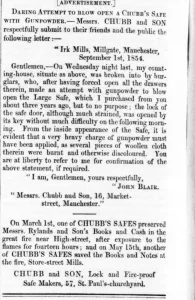 From the advert collection · 1854Daring Attempt to Blow Open a Chubb’s Safe with GunpowderThe burglars brought gunpowder; the strained lock still opened with its key the next morning.See the advert →
Victorian Chubb safes
Writing in 1875, George Hayter Chubb said the firm’s safes came “chiefly in two distinct qualities”. The best had diagonal bolts shooting into a solid frame that overlapped the body plates, with edges joined by angle iron, rivets and screws. John Chubb’s defence against drilling was simple and rather clever: hard steel screws set into the door plate around the lock, which broke the edge of any drill that touched them.5
An 1874 patent introduced a cheaper but strong design: a solid T-iron frame, a slightly recessed door to resist wedges, bolts that shot behind the frame rather than into the lining, and a “steam tube” that released steam into the safe in a fire.5 From 1866 large safes and strongroom doors were made at Glengall Road, Old Kent Road, a covered works of about 6,000 square yards. In 1882 the business was incorporated as Chubb & Son’s Lock and Safe Co. Ltd.1
Wolverhampton and the overseas companies

In 1908 the London safe works closed and safe making moved to a new factory at Wednesfield Road, Wolverhampton, extended in 1938 for the firm’s 120th anniversary to more than six and a half acres.1 In 1923 Chubb made a 20-ton circular steel treasury door, described as the first of its kind in Britain.3
Chubb safes were shipped to Australia from the early 1850s. Chubb’s Australian Company was founded in Sydney in 1897 and opened its own works at Waterloo, Sydney, in 1921.7 Our guide to Australian safe makers has the rest of the story. In South Africa, Chubb and Maxwell opened a depot in Cape Town in 1891. Later companies followed in Canada (manufacturing from 1954; Chubb-Mosler and Taylor Safes from 1960), Rhodesia (1957), New Zealand (1962) and Belgium (1967).8 So if you’re in Australia, New Zealand or Canada and your “British” Chubb has a local plate, that’s why.
Chatwood-Milner, TDR and the end of the family firm
After the Second World War Chubb grew from a single safe-making firm with two overseas subsidiaries into a group working in the UK and 17 other countries.3 It bought Hobbs Hart in 1956, and in 1958 bought Chatwood-Milner, the 1956 merger of Chatwood of Bolton and Milner’s Safe Company. Milner production at Speke stopped in 1960, and the Chatwood-Milner name was dropped in 1971 except in some export markets.9
In 1962 Chubb introduced TDR (torch and drill resisting) safes. Instead of layers of steel plate, the body was a seamless “bell” casting of aluminium containing very hard inclusions, and the door carried a slab of the same material. Newer rivals could not obtain TDR and had to keep laminating steel, chilled cast iron and concrete.10 Chatwood-Milner sold its own versions under the Duplextra name.9
Racal Electronics took over Chubb in 1984. Racal demerged it in 1992 as Chubb Security plc, and Williams Holdings bought that company in February 1997. In 2000 Williams sold the Chubb lock business to Assa Abloy, while the safe, strongroom and security screen divisions went to the Swedish group Gunnebo, which already owned Tann, Rosengren and Fichet-Bauche.8
By then Chubb had stopped making safes in England. A former Chubb export manager recalls that under Williams the Wednesfield Road factory closed and safes and fire-resisting cabinets were bought in from factories in Indonesia and Malaysia, ending more than 150 years of Chubb safe making in Britain.11 Who makes Chubb safes now is covered further down.

Old Chubb safe models you are likely to meet
Chubb didn’t go in for catchy model names. It sold safes by grade and range name, and even the grade was rarely written on the door, so pinning down what you have takes some cross-checking. Combine the plate (see the dating clues below) with the construction and size. These are the names that appear in Chubb’s catalogues, its staff’s recollections and today’s second-hand market.
| Name | Era | What it is |
|---|---|---|
| Two qualities, wrought iron | 1860s–1880s | In 1875 Chubb’s safes came “chiefly in two distinct qualities”: the best with diagonal bolts into a solid frame, and a cheaper patent safe of 1874 with a T-iron frame, a slightly recessed door and a “steam tube”.5 |
| Book, Standard, Jewel and Bankers | By 1915 | Four grades, each in ten sizes, priced from £10 10s to £193 10s; also sold as “plate safes” without the fire-resisting lining, for silver and coin.12 |
| Treasury | 1930s onwards | Chubb’s top anti-blowpipe (torch-resisting) safe, about four tons; the name was also used for heavy strongroom doors. A 1938 Treasury strongroom door weighed 30 tons.1213 |
| Commerce and Standard ABP | 1950s | Chubb ranges in a two-tone finish. From 1959 the same safes were also sold in plain dark grey as the Chatwood-Milner Duplex Drill-resisting and Duplex Anti-blowpipe.9 |
| Stafford and Totfield | Around 1960 | Stafford was Chubb’s light safe, the rival to Milners’ Merlin. Totfield safes were former Chatwood anti-blowpipe designs made at Shrewsbury and sold by Chubb salesmen.9 |
| TDR, first to third strength | From 1962 | Torch and drill resisting safes with a cast body (see below). The third strength was the Bankers grade; Chatwood-Milner sold the same safes as Duplextra Mk 1 to Mk 3.910 |
| Bankers Treasury | Early 1970s onwards | Introduced to replace third-strength Bankers safes for large cash holdings; a Mk 2 followed.1415 |
| Lichfield | Post-war (not dated) | A compact cash safe still common on the second-hand market: one reconditioned example is 635 mm high, weighs 300 kg and carries a £4,000 cash rating.16 |
| Chubbsafes ranges | 2000 onwards | Gunnebo-era safes graded under European standards; the Trident range dates from 2010.1718 |
TDR: why 1960s Chubb safes look different
In 1962 Chubb introduced TDR (torch and drill resisting) safes in three strengths. Instead of layers of steel plate, the body was a seamless “bell” casting of aluminium containing very hard inclusions, and the door carried a slab of the same material. Rival makers couldn’t obtain TDR and had to keep laminating steel, chilled cast iron and concrete.109 Run a hand over the body of yours: if it’s smooth and seamless, with no visible plate joints, that’s a good sign of a TDR-era Chubb.
Other Chubb equipment you may find
- Fire-resisting cabinets and files: Chubb made a range before the Second World War, fire-resisting files in the 1980s and data protection cabinets for computer media.13
- Wall safes, night safes and safe deposit lockers: all made at Wednesfield Road; safe deposits were a large export line.13
- Strongroom and vault doors: from small doors to the 25-ton circular door shown above.8
- Time locks: a Chubb-marked time lock of about 1900 was made by Sargent & Greenleaf of New York, and many Bankers safes had a Chubb 7L60 mechanical time lock.1914
How to identify and date a Chubb safe
Start with the maker’s plate on the door, then look at the lock and its number. Between them they’ll usually narrow it to a few decades, and a numbered lock can give you an exact date. The same method works for other makers: see our guide on how to date an old safe.
Clue 1: the wording on the plate
- “Chubb & Son” alone: before the 1882 incorporation.3
- “Chubb & Son’s Lock & Safe Co. Ltd”: 1882 or later.1
- “Makers to the Queen” with a London address of before 1941 (St Paul’s Churchyard or Queen Victoria Street): Queen Victoria’s reign, so before 1901. Chubb’s Victorian works were lettered “makers to the Queen and the Prince of Wales”.1
- “By Royal Appointment” to the King: 1901–1952, when Britain had kings. A Chubb safe of about 1910 with a 128 Queen Victoria Street badge carries a warrant to the King.20
- “Chatwood-Milner”: 1956–1971, Chubb-owned from 1958.9
- “Chubbsafes” logo: a Gunnebo-era safe, 2000 or later.17

Clue 2: the address
Plates and lock cases often carry a London address. The years are those recorded for each office or works; treat them as guides, not exact start and end dates.8
| 57 St Paul’s Churchyard | Head office in the 1820s to 1877 |
| Cowcross Street, Smithfield | Safe works from 1837 (still there in 1851) |
| Glengall Road, Old Kent Road | Safe works 1866–1908 |
| 128 Queen Victoria Street, EC | Head office 1877–1941 (bombed in the Blitz) |
| Wednesfield Road, Wolverhampton | Safe works from 1908 |
| 40–42 Oxford Street, W1 | Head office, late 1940s |
| 175–176 Tottenham Court Road | Head office, early 1950s |
| Totfield House, Tottenham Street, W1 | Head office from 1960 |
Sources differ on some dates. The London Archives’ catalogue dates the St Paul’s Churchyard office from 1827 and the move to Glengall Road to 1867, and Grace’s Guide gives 1837 for Glengall Road, which seems to confuse it with Cowcross Street.213
Clue 3: overseas plates

A plate naming a local company tells you where the safe was sold, and often where it was made:
- Chubb’s Australian Co.: 1897 or later; “Manufactured in Australia” plates suggest local manufacture, which was under way by 1921.
- Chubb and Maxwell, Cape Town: from 1891; South African manufacture from 1950.
- Chubb-Mosler and Taylor (Canada): 1960 or later. See our entry on J. & J. Taylor of Toronto.
- Chubb Lock and Safe Co. (New Zealand): 1962 or later.8
Clue 4: the lock serial number
If your lock has a number, you’re in luck: this is the best Chubb dating tool. Chubb stamped a serial number on each lock it made, and the numbers ran into the millions. It stopped serial numbering after 1936, so a Chubb lock with no number, or with only a code such as 3G110, is probably later. Our safe serial number lookup explains how to ask the Chubb Archive to check a number.22 The numbers below come from dated locks in the Chubb Archive’s registers and show how the sequence ran:23
| 452 | December 1819 |
| 6037 | 1827 |
| 37926 | November 1838 |
| 122567 | 28 February 1843 (a safe lock with detector) |
| 220073 | May 1850 |
| 355357 | December 1859 |
| 617128 | July 1870 |
| 1270428 | April 1893 |
| 1619807 | October 1909 |
| 1781067 | December 1921 |
| 1833986 | July 1928 |
For an exact date, the Chubb Archive’s curator will look up a lock number on request.23 Chubb’s own lock and safe number registers (from 1819) and order books survive at The London Archives (formerly London Metropolitan Archives), reference CLC/B/002, along with records of Hobbs Hart, Chatwood, Chatwood-Milner and Milner’s. The catalogue notes that they are “of particular value for dating locks and safes”. Many head-office records were lost when Queen Victoria Street was bombed in 1941.21
Worked example
A plate reads “Chubb & Son’s Lock & Safe Co. Ltd, makers to the Queen, 128 Queen Victoria St”. The company name means 1882 or later, the address 1877–1941 and “the Queen” before 1901: so 1882–1901. A lock number of around 1,270,000 would narrow it to about 1893.
Did you know?
The lock date is not always the safe date. Locks were made in batches and sometimes replaced, so a lock number gives the year the lock was made, and the safe is usually the same age or slightly younger.
What is an old Chubb safe worth?
Probably less than you’re hoping, unless it’s early, decorative or a high grade in good working order. Grey and green office safes of the 1950s to 1980s are bought to be used, so their price follows their insurance cash rating, condition and keys rather than age. Victorian safes are bought as antiques, and original paint, a clear plate and a working lock with its keys count most. Prices seen in October 2026:
| Safe | Price | Kind of price |
|---|---|---|
| Chubb Lichfield, reconditioned, 300 kg | £240 plus VAT and £110 delivery | Dealer, Coventry16 |
| “Chubb & Sons” safe with keys | £400 | Private, asking24 |
| Chubb, about 300 kg, with keys | £100 | Private, asking |
| Chubb, 525 kg | £550 | Private, asking |
| Chubb commercial safe “three people can’t lift” | £50 | Private, asking |
Good Chubb grades have always had a resale market. In the early 1970s Chubb’s Birmingham branch took back a National Coal Board client’s third-strength Bankers safes at £220 each in part exchange, overhauled them and sold them all within six weeks at about three quarters of the price of a new Bankers Treasury.14 A former export manager wrote that specialist dealers still keep “a very active market” for old high-quality Chubb safes.11
These are examples, not valuations, and asking prices are not selling prices. Moving a heavy safe can cost more than it sells for. Our guide are old safes worth anything? has more prices, what adds and kills value, and how to sell or rehome a safe.
How much does an old Chubb safe weigh?
More than it looks. In 1875 George Hayter Chubb published the least a sound fire-resisting safe of each size should weigh, and told buyers to insist on the weight being stamped on the safe.5 Three of his figures, with later Chubb examples:
| Safe | Weight |
|---|---|
| Victorian safe, 17 × 22 × 16 in (43 × 56 × 41 cm) | 3 cwt (152 kg) minimum5 |
| Victorian safe, 28 × 44 × 24 in (71 × 112 × 61 cm) | 11 cwt (559 kg) minimum |
| Victorian double-door safe, 48 × 84 × 30 in (122 × 213 × 76 cm) | 42 cwt (2,134 kg) minimum |
| Chubb Lichfield cash safe, 635 mm high | 300 kg16 |
| Treasury anti-blowpipe safe, 1930s | About 4 tons12 |
Burglar-resisting and bankers’ grades of the same size are heavier, and Chubb noted that steel-lined safes were “very much heavier”.5 The full 1875 table, other makers’ figures and floor loading are on our page how much does an old safe weigh?, and the safe weight calculator estimates a weight from your measurements.
Chubb safe keys, combinations and locked-out safes
Most old Chubb safes have a key-operated lever lock. The key has a round shank and a flag-shaped bit cut in steps, one for each lever, and in Britain any key like that gets called a Chubb key, whoever made it. Our guide what is a Chubb key? explains the name, how to read an old safe key and how to get a replacement.
Later and export safes may have a combination dial instead, like the Australian safe pictured above. The Manifoil keyless combination lock, designed by Milners, was improved by the Chubb group after 1958 and made at Wolverhampton from 1960.9 For how old dial locks work and why they stick, see old safe combination locks.
If the key is lost or the safe won’t open, call a qualified safe engineer rather than forcing it: most old lever locks can be opened and a new key made without damage. Have the lock number, photographs and proof that the safe is yours ready. Our guide to replacement keys for old safes explains what a new key involves. If you’re stuck right now, our guide to being locked out of an old safe covers the options and typical costs.
Moving or getting rid of a Chubb safe
Even the smallest safe in Chubb’s 1875 table weighed about 152 kg, far more than anyone should lift, so this is a job for a specialist safe remover with a stair-climbing trolley, not for friends and a sack truck.5 Upstairs or on a suspended timber floor, have the floor checked first. A Chubb safe set into concrete is usually best left in place and mentioned in a house sale. Our guide on how to move or get rid of an old safe covers costs, selling, scrap and who to call.
Chubb locks: what happened to the lock business
Chubb was a lock maker before it made safes. Lock making ran in Temple Street, Wolverhampton, until 1836, then at Horseley Fields from 1838 until the lease ran out in 1882. It moved to the Glengall Road works in London until a purpose-built lock works opened in Railway Street, Wolverhampton, in 1898; you can still read the Chubb name in the brickwork of that listed building near the station. In 1938 lock making joined the safe works at Wednesfield Road.119
From 1947 Chubb added a range of locks made from machined parts alongside its hand-made ones, and in 1965 it bought Josiah Parkes & Sons, makers of Union locks. Chubb High Security Locks, which made prison locks, became a separate division in 1989, and between 1996 and 1998 ordinary lock making moved to Union’s factories in Willenhall.18 Assa Abloy bought the lock business in 2000; when the Chubb Locks brand licence expired in 2010, the same products were sold as Union and Yale.25
So a “Chubb lock” bought in Britain today is usually a lever mortice deadlock by another maker: the name has become generic (see Chubb keys above).
Who makes Chubb safes today?
The Swedish Gunnebo group, which bought Chubb’s safe, strongroom and security screen businesses in 2000.8 It sells them as Chubbsafes: the Chubb brand belongs to Chubb plc and is a registered trademark used by Gunnebo under licence. The Trident range followed in 2010 and a new graphic identity in 2015.17 Modern Chubbsafes products are graded for burglary resistance (Grade I to VI) and fire resistance by an independent certification body.18
They aren’t made in Wolverhampton any more. Gunnebo’s plant at Halol in Gujarat, India, opened in 1984 and expanded in 2024, became its largest factory, and the company said it “will continue to produce high grade safe storage products under the iconic Steelage and Chubbsafes brands”.26 For a modern Chubbsafes safe, start with Gunnebo or one of its dealers; for an old Chubb & Son safe, an independent safe engineer.
Just to confuse matters, two other companies use the name. Chubb Fire & Security, the alarms and fire protection business, went to United Technologies in 2003, Carrier in 2020 and APi Group in 2022; it no longer makes locks or safes.27 Chubb the insurer is unrelated: it began as a marine underwriting firm in New York in 1882 and its name passed to ACE in 2016.28
Myths and unverified claims
Chubb was founded in 1818 by Charles Chubb as a lock company.
The brothers were ironmongers from 1804; 1818 is the year of Jeremiah’s detector lock patent and the Wolverhampton workshop.
The “Great Lock Controversy” happened in 1835.
It happened in 1851, when Hobbs picked a Chubb lock during the Great Exhibition.
Chubb moved all production to Wolverhampton in 1868.
Large safes were made at Glengall Road, London, until 1908.
Chubb partnered with Gunnebo in 1992.
In 1992 Chubb was demerged from Racal; Gunnebo bought the safe business in 2000.
New Chubb safes are still made in Wolverhampton.
Safe making in England ended around 2000; Gunnebo’s factory at Halol in India makes Chubbsafes products.
Chubb the insurer made Chubb safes.
The insurer is an unrelated American firm founded in 1882; the safes come from Charles and Jeremiah Chubb’s business.
I have an old Chubb safe: what now?
Date it
Record the details
Photograph the plate, the keyhole escutcheon and any numbers on the lock, door edge or key. A lock number from before 1936 can often be dated exactly.
Open it
Lost the key?
Call a qualified safe engineer. Never post a photo of a working key or a combination online.
Ask us
Not sure what it is?
Send photographs of the plate, lock and numbers and we’ll help you identify and date it.
Send us photos of the plate, lock and any numbers and we’ll help you identify and date your safe. Our guide on what to do with an old safe walks through the other steps. Thinking of buying one? Read our guide to buying a second-hand safe first. If the plate names another firm, look it up in our list of old safe brands.

Adverts in the collection

Frequently asked questions
How old is my Chubb safe?
Look at three things: the plate wording (“Lock & Safe Co. Ltd” means 1882 or later), the address (128 Queen Victoria Street means 1877–1941) and the lock number, checked against the table above. Locks numbered before 1936 can be dated precisely from Chubb’s registers.
Where is the serial number on a Chubb safe, and can I check it?
The number Chubb recorded is the lock’s serial number, stamped on the lock itself rather than on the plate. Chubb stopped serial-numbering locks after 1936, so a later lock may have none. The Chubb Archive will look up a number from its registers if you ask.
What is an old Chubb safe worth?
Usually not a fortune. Most 20th-century Chubb office safes sell for tens to a few hundred pounds; in October 2026 a reconditioned Chubb Lichfield was £240 plus VAT from a dealer, and private sellers were asking £50 to £550. Early or decorative Victorian safes in original condition with keys are worth more.
How heavy is an old Chubb safe?
Chubb’s 1875 guide put the smallest sound safe at 3 cwt (152 kg) and a large double-door safe at 42 cwt (2,134 kg). A Lichfield cash safe weighs about 300 kg and a 1930s Treasury about four tons.
Who makes Chubb safes today?
The Swedish Gunnebo group, which bought Chubb’s safe business in 2000 and sells safes as Chubbsafes under licence. Its largest factory is at Halol in India.
Are Chubb locks still made?
Not under that name. Assa Abloy bought the lock business in 2000 and, after the brand licence expired in 2010, sold the same products as Union and Yale.
Who invented the Chubb lock?
Jeremiah Chubb patented the detector lock on 3 February 1818. His brother Charles Chubb built the business that sold it.
Can I get a key for an old Chubb safe?
Usually, yes. A specialist safe engineer can open a lever lock and make a new key from it without damaging the safe; avoid drilling or forcing the door.
Sources:
- The Chubb Archive (History of Locks Museum), “Chubb 1818–1990s”. ↩︎
- The Chubb Archive, “The detector mechanism”. ↩︎
- Grace’s Guide, “Chubb and Son”. ↩︎
- safeman.org.uk, “About safes”. ↩︎
- George Hayter Chubb, Protection from Fire and Thieves (London, 1875), chapter on safes, lists of patents and ch. V (“Weights of good safes”), via Project Gutenberg. ↩︎
- The Chubb Archive, Lock Register 1841–1850, lock No. 137850 (5 December 1843). ↩︎
- “More British Capital. Lock and Safe Manufacturing”, Daily Commercial News and Shipping List (Sydney), 2 March 1921, p. 10, via Trove. ↩︎
- The Chubb Archive, “Early sales, offices, Chubb Group, 1980s and on”. ↩︎
- The Chubb Archive, “Chatwood-Milner”. ↩︎
- safeman.org.uk, “Modern times”. ↩︎
- D. R. E. Ibbs, “Conclusions”, in Export is Fun, The Chubb Archive, chubbarchive.co.uk/page26. ↩︎
- safeman.org.uk, “Coming of age”. ↩︎
- D. R. E. Ibbs, “Intro and apprenticeship”, in Export is Fun, his memoir of 41 years with Chubb, The Chubb Archive, chubbarchive.co.uk/page15, with captioned photographs of the Wednesfield Road works. ↩︎
- D. R. E. Ibbs, “Back to the Midlands” (his years as Midlands manager from April 1971), in Export is Fun, The Chubb Archive, chubbarchive.co.uk/page21. ↩︎
- D. R. E. Ibbs, “The Midlands, again!”, in Export is Fun, The Chubb Archive, chubbarchive.co.uk/page24 (photograph captioned “Bankers Treasury Safe, Mk2”). ↩︎
- BDB Safe and Vault, Coventry, “Chubb Lichfield high security cash safe”, reconditioned, £240 ex VAT plus £110 delivery, 635 × 483 × 548 mm, 300 kg, £4,000 cash rating (checked 26 October 2026). ↩︎
- Chubbsafes, “About Chubbsafes”. ↩︎
- Wikipedia, “Chubbsafes” (grading by the European Certification Body). ↩︎
- The Chubb Archive, “Lock stories” (dated Chubb locks and where they were made). ↩︎
- 1stDibs, Adrian Alan Ltd, Brighton, “Antique mahogany safe cabinet with Chubb safe, England, circa 1910” (badge and warrant described in the listing; checked 26 October 2026). ↩︎
- AIM25 / The London Archives, “Chubb and Son Limited, locksmiths and safe manufacturers”, ref. CLC/B/002. ↩︎
- The Chubb Archive, “Post 1936 locks”. ↩︎
- The Chubb Archive, “Registers” and lock registers 1819–1936 (entries by serial number and date). ↩︎
- Gumtree UK search results, private asking prices (checked 26 October 2026; listings change daily): “antique safes”, “chubb safe” and “floor safes”. ↩︎
- Wikipedia, “Chubb Locks”, citing SafeZone, “Why did Chubb Locks change their brand?” (2013). ↩︎
- Steelage (Gunnebo India), news item of 30 April 2024 on the Halol plant expansion, quoting Gunnebo Group president and CEO Stefan Syren. ↩︎
- Wikipedia, “Chubb Fire & Security” (UTC 2003, Carrier 2020, APi Group 2022). ↩︎
- Wikipedia, “Chubb Limited” (the insurer: founded in New York in 1882; ACE adopted the Chubb name in January 2016). ↩︎


