

Sargent & Greenleaf never made safes. It made the locks on them: the dial on a great many American safes, the time lock on bank vaults since 1874 and the lock on US government security containers today. Here’s its history, and how to recognise one of its locks on your door.
1857
The year Sargent & Greenleaf dates its start from
1874
First Sargent time lock fitted to a bank vault, in Morrison, Illinois
2013
The S&G 2740B approved for US government classified containers
2025
High-security lock business sold to ASSA ABLOY
Key takeaways
- Sargent & Greenleaf (S&G) is a lock maker, not a safe maker. An S&G dial tells you who made the lock, not who built the safe.
- James Sargent, a former sales agent for Yale & Greenleaf, started making combination locks in 1857 by the firm’s own account and went into partnership with Halbert S. Greenleaf in Rochester, New York, in 1865.
- His time lock went onto a bank vault door in May 1874 and became the industry’s first commercial success. S&G still sells time locks today.
- The firm moved to Nicholasville, Kentucky, in the mid-1970s, passed through several owners, and sold its high-security lock business to ASSA ABLOY in December 2025.
- To change or recover a combination, use S&G’s published procedure with the right change key, or call a safe technician. Never take the cover off the lock.
In This Article

Sargent & Greenleaf at a glance
| Country | United States |
| Founded | 1857 (James Sargent’s own lock business, by the firm’s account); Sargent & Greenleaf organised in Rochester, New York, in 1865 |
| Founders | James Sargent (1824–1910) and Halbert S. Greenleaf (1827–1906) |
| Works | Rochester, New York (Court Street by 1910), until the mid-1970s; Nicholasville, Kentucky, since then; time locks made in Lausanne, Switzerland, from 1978 |
| What it makes | Combination and key locks for safes and vaults, time locks, safe deposit locks, high-security padlocks, electronic safe locks |
| Did it make safes? | No. Its locks were fitted by safe and vault makers |
| Owners | Founders and their successors; Harry C. Miller (1953); Security Group of Indianapolis (1980); The Stanley Works (2005); OpenGate Capital (2019); high-security lock division to ASSA ABLOY (December 2025) |
| Notable patents | Magnetic combination lock, US 47,575 (1865); time attachment for locks, US 186,369 (1877) |
| Best-known models | 6730 (Group 2 dial lock), 8400 (Group 1 manipulation-resistant lock), 2740B (US government electromechanical lock) |
Sources for the table are given in the sections below.1,2,3,4,5 The firm’s founding date depends on what you count: S&G counts from James Sargent’s first lock business in 1857, while the partnership with Greenleaf dates from 1865.
History of Sargent & Greenleaf
A lock salesman with a micrometer, 1857–1865
James Sargent was born in Chester, Vermont, in December 1824, spent his early years there and later moved to New Hampshire, where he married Angelina Morse Foster in 1847.2 By the firm’s own account he was a sales agent for Yale & Greenleaf, lock makers of Shelburne Falls, Massachusetts, when he set out in 1857 to build a more secure lock of his own.6 Halbert Greenleaf, his future partner, had organised the Yale & Greenleaf Lock Co.3
Sargent’s route to a better lock went through picking other people’s. His 1867 catalogue says he invented the “Micrometer” in 1860: an instrument fitted to a lock’s knob that measured movements of a ten-thousandth of an inch and could, it claims, pick most of the combination locks then in use.7 It’s a contest between lock makers and lock pickers that British readers will know from the story of Bramah’s locks. Sargent’s answer was to make his own instrument useless. In his magnetic lock, patented with H. W. Covert on 2 May 1865, a magnet holds the lever clear of the wheels, so nothing on the outside can feel the wheels’ gates through the knob.8,7 S&G later called the Magnetic Bank Lock the first successful key-changeable combination lock, and says safe makers and the US Treasury Department took it up.6
The 1867 catalogue is worth a look for its own sake. Its engraved lock plates are covered in scrollwork, its price list runs from $12 for an iron two-wheel “Safety Fund” lock to $300 for the No. 1 Magnetic in bronze, and Sargent says that 9,000 of his permutation wheels had been made without a single failure he knew of.7 It’s signed “James Sargent, Rochester, July 1867”, with no Greenleaf in sight, even though the company dates the partnership to 1865.
Sargent & Greenleaf in Rochester, 1865–1900
Sargent and his wife moved to Rochester, New York, in 1864, and he lived there for the rest of his life.2 Greenleaf took a longer road. He enlisted as a private in 1862, was elected colonel of the 52nd Massachusetts Volunteers that October, worked at a salt works near New Orleans after the war, and settled in Rochester in 1867 to make locks again. He later served two terms in Congress, from 1883 to 1885 and from 1891 to 1893.3 The company gives 1865 as the year Sargent & Greenleaf was first organised in Rochester, and 1869 as the year it won its first federal contract, for safe locks for the Treasury Department.1
The time lock made the firm’s name. Sargent applied for a patent in June 1873, and the first Sargent time lock went onto the vault door of the First National Bank of Morrison, Illinois, in May 1874.2,6 The company’s own timeline puts the invention in 1872, so the sources don’t quite agree.1 That first year S&G sold a Model 2 with two clock movements for about $400; a time lock collector calls it the first large-scale, commercially produced time lock.9 The patent took longer. The examiner rejected his application of June 1873 several times before it finally became US 186,369, for a twin-movement time attachment, granted on 16 January 1877.10,11
Sargent then went to court to defend it, and lost. He sued the Hall Safe & Lock Co. of Cincinnati for infringing patent 186,369; the lower court dismissed the case, and in March 1885 the US Supreme Court agreed, reading his claims so narrowly that Hall’s sliding-bolt design fell outside them.10 The market was shared out anyway: the collector’s history says S&G and Yale came to an arrangement in 1877 and issued a joint catalogue in 1883.9

Sargent kept inventing well beyond locks. His Rochester obituaries list an automatic railway signal, a smoke consumer that saved coal, and a glass-enamelled steel tank that brewed beer in twenty days instead of three months. He was president of Sargent & Greenleaf, “manufacturer of locks and keys, in Court street”, when he died at his home on East Avenue in January 1910.2 Our guide to how bank time locks work tells the wider story of the trade he started.

Jail locks, war work and the MP lock, 1900–1974
By 1910 the catalogue ran far beyond bank work: combination, key, time, safe, door, cabinet, padlock, prison, gate, trunk and post office locks. S&G says it made jail locks from 1874 and was one of the largest producers until the early 1950s.1 Time lock dials read “Sargent & Greenleaf Company” from 1896 and “Sargent & Greenleaf, Inc.” after the firm became a stock company in 1918.9 Between the wars it added builders’ hardware, including a reversible panic exit device, and in the Second World War it turned to ordnance; the company mentions guidance systems for torpedoes and special combination locks for weapon storage, the Locksmith Ledger fuses for depth charges.1,4
The man who shaped the modern firm was Harry C. Miller, who joined after the war. He developed a patented combination lock built to resist manipulation, which US government agencies adopted quickly, became owner and president in 1953, and dropped most of the old hardware lines to concentrate on safe and vault locks, safe deposit locks and special devices.4 The company dates its first “MP” (manipulation-proof) lock for government cabinets and safes to the period from 1948, and its catalogue calls today’s 8400 series “the direct descendant of the original MP Manipulation Proof combination lock”.1,12 Time lock production slowed after 1929, and from the 1950s the movements were made abroad by subcontractors.9
Nicholasville and a run of new owners, 1974 to today
After more than a century, S&G left Rochester for a new plant in Nicholasville, Kentucky, near Lexington. The company gives 1974 for the move, the Locksmith Ledger 1975 for the closing of the Rochester factory.1,4 In 1978 it opened a time lock works and European sales office in Lausanne, Switzerland, and time locks have been built there since.1,9 Miller sold the company to Security Group of Indianapolis in 1980.4 Electronic safe locks followed with the 6120 series, in production from 1993 by the company’s timeline (the Ledger says 1994).1,4
The 21st century has been a string of sales. The Stanley Works bought S&G in January 2005 and ran it as part of Stanley Security Solutions.4 Stanley Black & Decker agreed to sell it to the private equity firm OpenGate Capital in early 2019, and the deal was done that May.13,5 Then, in a release dated 3 December 2025, OpenGate announced that S&G had sold its high-security locking division to ASSA ABLOY, while the Delaney Hardware business stayed with OpenGate.5 The Locksmith Ledger put the business at about 100 employees and roughly $45 million in 2024 sales, still in Nicholasville.14 S&G’s website now describes it as part of the ASSA ABLOY Group.15
Timeline
- 1857 James Sargent begins making his own locks (the firm’s founding date).
- 1865 Magnetic lock patent; Sargent & Greenleaf organised in Rochester.
- 1869 First federal contract, safe locks for the US Treasury.
- 1874 First Sargent time lock fitted, at Morrison, Illinois.
- 1877 Time lock patent 186,369 granted.
- 1953 Harry C. Miller becomes owner and president.
- 1974–1975 Move from Rochester to Nicholasville, Kentucky.
- 2005 Bought by The Stanley Works.
- 2019 Sold to OpenGate Capital.
- 2025 High-security lock division sold to ASSA ABLOY.
The S&G locks you’re most likely to meet
Most owners never see the lock itself. It’s screwed to the inside of the door behind a cover, and only the dial and its ring show on the outside.16 Underwriters Laboratories grades mechanical combination locks under its standard UL 768: Group 2 locks have a moderate degree of resistance to unauthorised opening, Group 1 locks a high degree of resistance to expert manipulation, and Group 1R adds protection against X-ray imaging.16 These are the S&G lines that come up most, as S&G itself describes them.
| Line | What it is | Where you’ll find it |
|---|---|---|
| 6730 series | Three-wheel mechanical dial lock, UL Group 2; S&G calls it “the standard Group 2 lock of the industry”. The 6731 has four wheels | Commercial and home safes |
| 8400 series | Three-wheel manipulation-resistant lock, UL Group 1 (8410, 8415) or Group 1R (8430, 8435), with a small “butterfly” knob on the dial | Higher-security safes and containers |
| 2740B | Battery-powered electromechanical dial lock meeting Federal Specification FF-L-2740B | US government security containers and vault doors |
| Time locks | Two- or three-movement mechanical time locks with Swiss 13-jewel movements, listed under UL 887 | Bank vaults and large safes |
| Safe deposit locks | Changeable key locks for the boxes in a bank vault | Bank safe deposit vaults |
| 8077AD and 951 padlocks | Government-specification combination padlock and a key-retaining high-security padlock | Military and government sites |
The catalogue details behind the table: the 6730 and 8400 both offer 1,000,000 theoretical combinations, the four-wheel 6731 100,000,000, and the 8400 is tested by Underwriters Laboratories to resist 20 man-hours of expert manipulation.12 The 8077AD padlock was built to government specifications with 30 minutes’ protection against expert manipulation and 125,000 possible combinations; the 951 has a cast stainless steel body and a shrouded shackle.12 The Locksmith Ledger adds that one S&G padlock was used by virtually all North American railroads to protect their switching equipment.4
Safe deposit locks have a long history at S&G too. A 1981 patent assigned to the firm, for a double changeable key lock, explains why banks change box locks between renters; our guide to identifying safe deposit box keys picks up that story.17

S&G and the US government lock
Government work runs through the whole story, from the Treasury contract of 1869 to a Defense Department contract for high-security padlocks in 1988.1 Its best-known modern form is Federal Specification FF-L-2740. Since 10 March 1992, GSA-approved security containers and vault doors for classified material have left the factory with an FF-L-2740 lock fitted, and since 15 February 2015 with one approved to the revised FF-L-2740B.18
Six locks have been approved under the specification for GSA security containers. The first was the Mas-Hamilton X-07 in February 1992; S&G’s model 2740 followed in June 2010 and the 2740B in November 2013. Its competitor is the Kaba Mas X-10, approved in April 2013.18 You won’t find a 2740B at the hardware shop: the specification limits sales to the federal government, authorised contractors and others the government specifically authorises.18 S&G’s catalogue sells it on speed, with a familiar left-right-left dial and no turns to count.12 Our explainer on SCIFs and GSA security containers covers the rooms and cabinets these locks protect.
Did you know?
Sargent had a nickname in his lifetime. A newspaper in Augusta, Georgia, wrote in January 1905 that he was known as “the Rochester Edison”.2
How to identify an S&G lock on your safe
Start with the dial ring, because it’s the part you can see with the door shut. Then, with the door open, look at the lock case on the inside of the door, but don’t take its cover off.19
Clue 1
Two marks on the ring
S&G rings carry an opening index, often called the “crow’s foot”, and a changing index 8½ numbers to its left. A spy-proof dial hides the numbers from anyone beside you.16
We couldn’t find an S&G document that says exactly where the model number is marked on each lock, so treat the pictures here as a guide: the padlock above carries it on the body, and on safe locks look on the case and cover. If the number’s worn away, the dial and ring numbers help, because S&G lists which dials fit which lock families: its standard front-reading and spy-proof dials for the 6730 family are not for use on its Group 1 locks.12
| “James Sargent”, Rochester | Sargent’s own name; his 1867 catalogue still used it |
| “Sargent & Greenleaf Company” | On time lock dials from 1896 |
| “Sargent & Greenleaf, Inc.” | After the 1918 reorganisation as a stock company |
| Rochester, N.Y. | Made before the move in the mid-1970s |
| Nicholasville, Kentucky | Made after the move |
| Lausanne, Switzerland | Time locks made from 1978 |
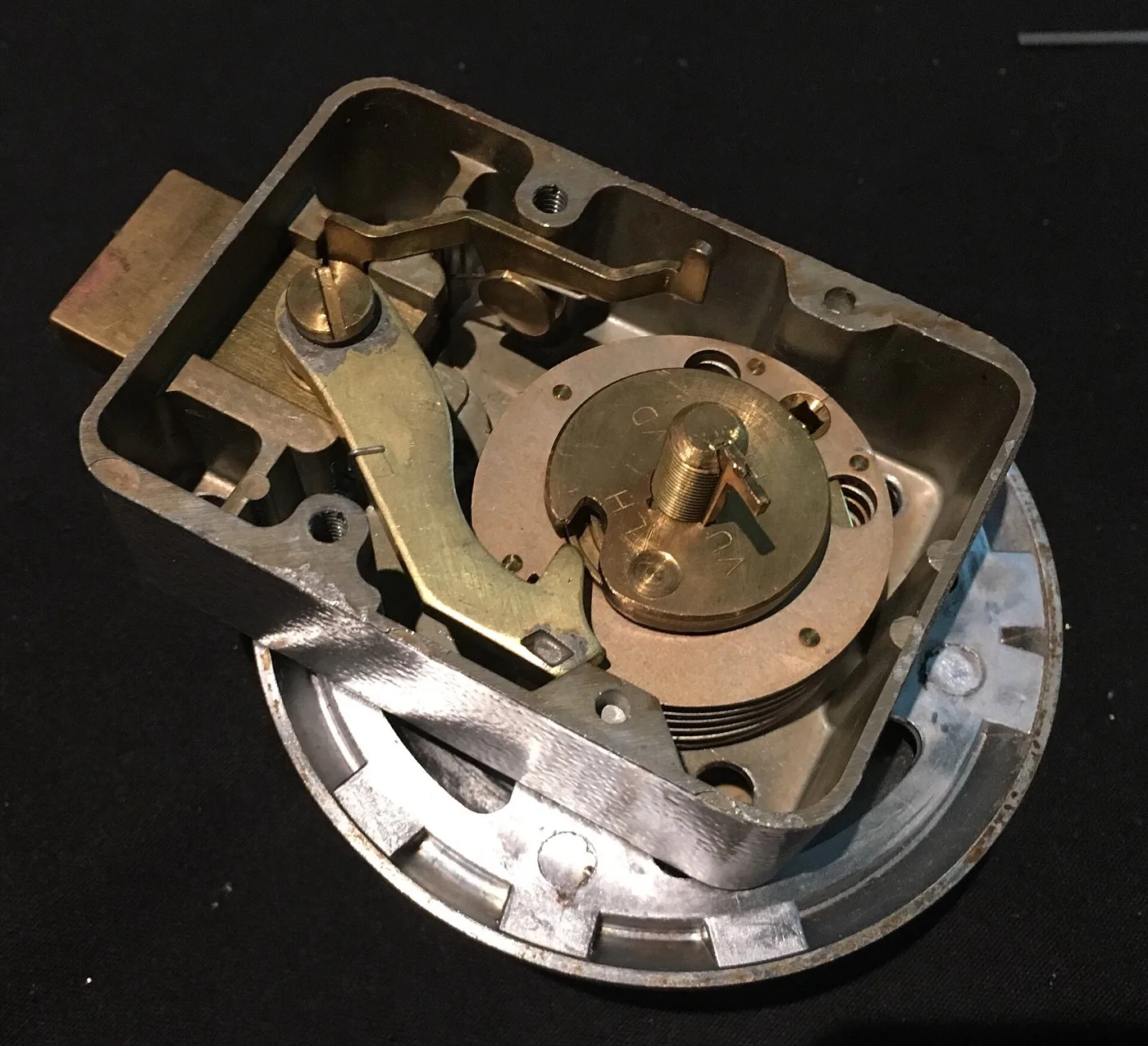
Remember what an S&G dial doesn’t tell you: who made the safe. Look for the safe maker’s own plate, label or casting on the door. Not sure what you have? Send us photos of the dial, the lock case and any maker’s plate, with the outside size of the safe, and we’ll help you date it.
Myths and mix-ups
My safe was made by Sargent & Greenleaf.
S&G made the lock. The safe came from another maker, who bought and fitted S&G’s lock.
James Sargent invented the time lock.
Earlier designs existed, and the Patent Office cited them against him. His was the first to sell in numbers, from 1874.
S&G is part of Kaba or dormakaba.
Kaba Mas is a rival maker (the X-10). S&G’s high-security lock business went to ASSA ABLOY in December 2025.
The time lock point is spelled out in the Supreme Court’s 1885 judgment, which notes that the patent examiner rejected Sargent’s first application by citing earlier patents: Hollen’s of 1871, Rutherford’s of 1831 and Holbrook’s of 1858.10 The ownership points come from the DoD Lock Program’s list of approved locks and OpenGate’s 2025 announcement.18,5
I have a safe with an S&G lock: what now?
Changing
Changing the combination
Follow S&G’s procedure for your model, with its change key (for the 8400, a 6720). Test the new numbers several times with the door open. No key or manual? Ask a safe technician.19
Locked out
Lost combination
Call a qualified safe technician; in the US, a SAVTA member is a good start. Expect to be asked to show the safe is yours.20
If you have an old safe and the combination card that came with it, our guide to old safe combination locks walks through dialling a known combination, the usual mistakes, and what S&G and other lock makers say about servicing. An old time lock on a safe or vault door is a job for a technician too: have it checked before you close the door on it.
Frequently asked questions
Does Sargent & Greenleaf make safes?
No. It makes locks for safes, vaults, safe deposit boxes and government containers. The safe itself came from another maker, so look for that maker’s plate on the door.
How old is my Sargent & Greenleaf lock?
Check the name and town on it. “Rochester, N.Y.” means it was made before the move to Nicholasville, Kentucky, in the mid-1970s. A model number such as 6730, 8400 or 2740B dates it more closely, because each line has its own history.
How do I change the combination on an S&G lock?
Use the change instructions S&G publishes for your model and the correct change key, with the door open, and test the new combination several times before closing it. If you don’t have the key or the instructions, ask a safe technician.
Who owns Sargent & Greenleaf now?
Its high-security lock division was sold to ASSA ABLOY in December 2025, after six years with OpenGate Capital and fourteen with Stanley. S&G describes itself as part of the ASSA ABLOY Group.
Where are Sargent & Greenleaf locks made?
In Nicholasville, Kentucky, since the mid-1970s, with time locks made in Lausanne, Switzerland, from 1978. Before that, for more than a century, in Rochester, New York.
Sources:
- Sargent & Greenleaf, “Company history”, timeline 1857 to 2005 on the company’s legacy website (accessed 12 November 2026). ↩︎
- Obituaries of James Sargent, Democrat and Chronicle and Union and Advertiser, Rochester, 13 January 1910, transcription (PDF), New York State Convention of Universalists archive. ↩︎
- US House of Representatives, History, Art & Archives, “GREENLEAF, Halbert Stevens” (from the Biographical Directory of the United States Congress). ↩︎
- Locksmith Ledger, “A brief history of Sargent & Greenleaf on its 150th anniversary” (2007). ↩︎
- OpenGate Capital, “OpenGate Capital portfolio company Sargent and Greenleaf completes sale of security locking division to ASSA ABLOY”, press release dated 3 December 2025. ↩︎
- Sargent & Greenleaf, “Company info”, legacy website (accessed 12 November 2026). ↩︎
- James Sargent, James Sargent’s Descriptive Catalogue of Patent Magnetic Bank and Safe Locks (Rochester, July 1867), price list, patent notice and pp. 7 to 47, Library of Congress copy via Internet Archive. ↩︎
- James Sargent and H. W. Covert, of Rochester, New York, “Improvement in locks”, US patent 47,575, 2 May 1865 (magnetic combination lock), via Google Patents. ↩︎
- Mark Frank, “Sargent & Greenleaf, Rochester, New York, 1874 through today: introduction”, my-time-machines.net (bank vault time lock collection), drawing on John and David Erroll, American Genius (2006). ↩︎
- Sargent v. Hall Safe & Lock Co., 114 U.S. 63 (US Supreme Court, 30 March 1885), Legal Information Institute. ↩︎
- James Sargent, US patent 186,369, “Improvement in time attachments for locks”, 16 January 1877, via Google Patents. ↩︎
- Sargent and Greenleaf, product catalogue, US edition (revision date 23 June 2014), pp. 22, 24 to 31 and 38. ↩︎
- SecurityInfoWatch, “Sargent and Greenleaf to be acquired by OpenGate Capital”, 5 February 2019. ↩︎
- Locksmith Ledger, “ASSA ABLOY acquires Sargent and Greenleaf”, 5 December 2025. ↩︎
- Sargent & Greenleaf, contact page (“As part of the ASSA ABLOY Group”), accessed 12 November 2026. ↩︎
- Sargent & Greenleaf, Mechanical Safe Lock Guide (© 2006): “Model 6730, 6735, 6738, 6741 Mechanical Combination Lock”, operating instructions and “Combination Lock Glossary”, pp. 2 to 8, PDF, archived copy of January 2026. ↩︎
- James P. Peppard (assignor to Sargent and Greenleaf, Inc.), US patent 4,290,287, “Double changeable key lock for safe deposit boxes and the like”, filed 28 August 1979, granted 22 September 1981, via Google Patents. ↩︎
- DoD Lock Program (US Navy, NAVFAC EXWC), “Introduction to Combination Locks” (archived 23 January 2026). ↩︎
- Sargent & Greenleaf knowledge base, “How do I change my combination?” (8400 mechanical spin dial lock; accessed 12 November 2026). ↩︎
- Safe & Vault Technicians Association, savta.org, “Safe Tech Search” (“Find a qualified technician”). ↩︎
The History of Safes letter
One old safe a month, in your inbox
Once a month I send one safe worth a closer look, the new maker histories and a find from the patent and advert collection. Nothing else, and you can leave with one click.
You'll get a confirmation email first. One email a month, unsubscribe any time. Privacy policy.


