

Some of the most famous “failed” robberies weren’t failures at all. The thieves got into the vault, got out again with the loot, and were only caught later. Here are eight cases, sorted honestly into the raids that were stopped and the heists that worked until a fingerprint, a receipt or an informant brought the gang down.
Key takeaways
- Only three of these eight were truly foiled: Stockholm in 1973, the Millennium Dome in 2000 and Heathrow in 2004.
- The other five succeeded on the night; the robbers were caught afterwards, and most of the loot was never recovered.
- The vault door was rarely the weak point. Gangs went through roofs, floors and tunnels, or used an insider.
- Small traces undid them: dirty dishes in California, a bloody fingerprint in London, a bag of dumped rubbish beside a Belgian motorway.
In This Article

Eight robberies at a glance
“Failed” here means one of two things, and the table says which. A foiled raid was stopped before the robbers left with anything. A caught heist got away with the loot, and the gang was traced later.
| Robbery and target | Outcome | What went wrong for the robbers |
|---|---|---|
| United California Bank, Laguna Niguel, USA (1972): 458 safe deposit boxes | Caught | Fingerprints on plates left in a dishwasher |
| Norrmalmstorg, Stockholm, Sweden (1973): Kreditbanken branch | Foiled | Hostage siege; no money taken |
| Knightsbridge Safe Deposit Centre, London (1987): safe deposit boxes | Caught | A fingerprint left at the scene |
| Millennium Dome, London (2000): De Beers diamonds | Foiled | Police knew; the diamonds had been swapped for fakes |
| Antwerp Diamond Center, Belgium (2003): vault with 189 boxes | Caught | Dumped rubbish, a porter who knew the leader, and DNA |
| Swissport warehouse, Heathrow (2004): gold bullion and cash | Foiled | Armed police were waiting |
| Banco Central, Fortaleza, Brazil (2005): central bank vault | Caught | Arrests and asset seizures followed; most of the cash was never found |
| Harry Winston, Paris (2008): jeweller’s safes | Caught | An inside man and a long investigation |
Timeline
- 1972 The Dinsio gang breaks into United California Bank through the vault roof.
- 1973 A six-day siege at Norrmalmstorg gives the world the term “Stockholm syndrome”.
- 1987 Valerio Viccei’s gang empties boxes at the Knightsbridge Safe Deposit Centre.
- 2000 The Millennium Dome raiders drive into a police trap.
- 2003 Thieves open more than 100 boxes in the Antwerp Diamond Center vault.
- 2004 The Flying Squad stops a gold raid at Heathrow.
- 2005 A tunnel gang takes R$164.7 million from the Banco Central in Fortaleza.
- 2008 Robbers, some dressed as women, raid Harry Winston in Paris for the second time.
Robberies that were stopped
Norrmalmstorg, Stockholm, 1973: the robbery that named a syndrome
On 23 August 1973 Jan-Erik Olsson, a 32-year-old career criminal, walked into the Kreditbanken on Stockholm’s Norrmalmstorg square and took four employees hostage: Birgitta Lundblad, Elisabeth Oldgren, Kristin Ehnmark and Sven Säfström. A former prison mate, Clark Olofsson, later joined him inside the bank, and the hostages were held in the bank’s vault.1
As a robbery it failed completely: Olsson’s demand for a getaway car to leave with the hostages was refused, and nobody escaped with money. When the stand-off ended six days later, the hostages had formed an unexpected bond with their captors; Ehnmark had even told Prime Minister Olof Palme by phone that she trusted the robbers. The criminologist and psychiatrist Nils Bejerot is reported to have coined the phrase “Stockholm syndrome” to explain it.1

The Millennium Dome raid, London, 2000

On 7 November 2000 a gang crashed a heavy digger through the perimeter of the Millennium Dome in Greenwich. Their target was the De Beers diamond display, including the Millennium Star, a 203.04-carat, D-colour pear-shaped diamond.2 The plan was to smash the case with sledgehammers and a nail gun and escape down the Thames in a speedboat.3
The gang didn’t know it, but police had been watching them. The day before, the Dome was put on a high state of alert and 90 armed officers were moved into and around the building.4 The real diamonds had been swapped for fakes, so even a perfect smash-and-grab would have got them nothing but replicas. Officers disguised as cleaners and Dome staff arrested the gang, while the speedboat’s skipper was caught waiting on the river.3 We tell the whole story, from the police operation to the appeal, in our account of the Millennium Dome robbery.
Reports at the time valued the diamonds at £200 million. In February 2002 William Cockram and Raymond Betson were jailed for 18 years each, Robert Adams and Aldo Ciarrocchi for 15, and the skipper Kevin Meredith for five.4
The Swissport warehouse, Heathrow, 2004
On 17 May 2004 an armed gang reversed a white Transit van through the shutters of the Swissport cargo warehouse at Heathrow. Inside, they believed, were about £40 million in gold bullion and £30–40 million in cash, which had arrived that morning. The area had been under surveillance for weeks, and armed officers of the Flying Squad were lying in wait. They fired special rounds to deflate the van’s tyres, and seven men were arrested; one more escaped on foot.5
The detective in charge said the police had “foiled what would have been one of the biggest robberies ever committed in the UK”. Unlike most raids in this list, it really did fail.5
Heists that worked until the robbers were caught
Amil Dinsio and the United California Bank, 1972
Over the weekend of 24 to 26 March 1972, a crew from Youngstown, Ohio, led by the bank burglar Amil Dinsio, broke into the United California Bank at Laguna Niguel. They ignored the vault door, climbed onto the roof of the vault and went through its 18-inch concrete ceiling, cutting the reinforcing bars and using explosives. Over three nights they opened 458 safe deposit boxes.6
The gang had been told that President Nixon kept secret campaign cash in a local bank. They found no such money, but took cash, jewellery, stocks and bonds worth about $8 million by the Register‘s count; other estimates run from $9 million to $12 million.67
The burglary itself went to plan. The mistake came afterwards. A cleaning crew scrubbed the condominium the gang had used as a base, but the dirty dishes were simply loaded into the dishwasher. When the FBI opened it, they lifted the fingerprints of Amil and James Dinsio, Harry and Ronnie Barber, Charlie Mulligan, Charlie Broeckel and Phil Christopher from the plates.6 It’s hard to think of a more domestic way to get caught.
Amil Dinsio, Mulligan and Christopher were sentenced to 20 years each, James Dinsio and Ronnie Barber to 15. Broeckel entered witness protection. By early 1973 the FBI had recovered about half of the stolen property.6 Harry Barber escaped and lived for years under a false name before his arrest in 1980.7 His story became the 2019 film Finding Steve McQueen, co-written by Keith Sharon, the journalist who wrote the Register‘s serial.8
The Knightsbridge Safe Deposit Centre, London, 1987
On 12 July 1987 Valerio Viccei, an Italian suspected of dozens of armed robberies at home, robbed the Knightsbridge Safe Deposit Centre with the help of its owner, Parvez Latif. With security-guard uniforms, walkie-talkies and metal-cutting equipment, the gang cleared 114 boxes in under two hours. No shots were fired and nobody was hurt.9 Estimates of the haul vary: The Guardian gave £40 million, while the Guinness figure quoted by the BBC was £60 million.95
Viccei was traced through a fingerprint left at the scene and arrested at the wheel of his Ferrari. He was sentenced to 22 years, transferred to an Italian prison in 1992, and shot dead by police in April 2000 while on day release, apparently preparing another robbery. Only £10 million of the haul was ever recovered.9 London’s best-known safe deposit burglary came later, in Hatton Garden; we tell it in the Hatton Garden heist.
“Only £10m was ever recovered.”
The Guardian, on the Knightsbridge robbery, 2000
Viccei told his own version in Knightsbridge (1992). An earlier version of this article cited a book called “The Knightsbridge Robbery” by Tim Coates; we couldn’t find any such book, so we’ve removed it.10
The Antwerp Diamond Center, 2003
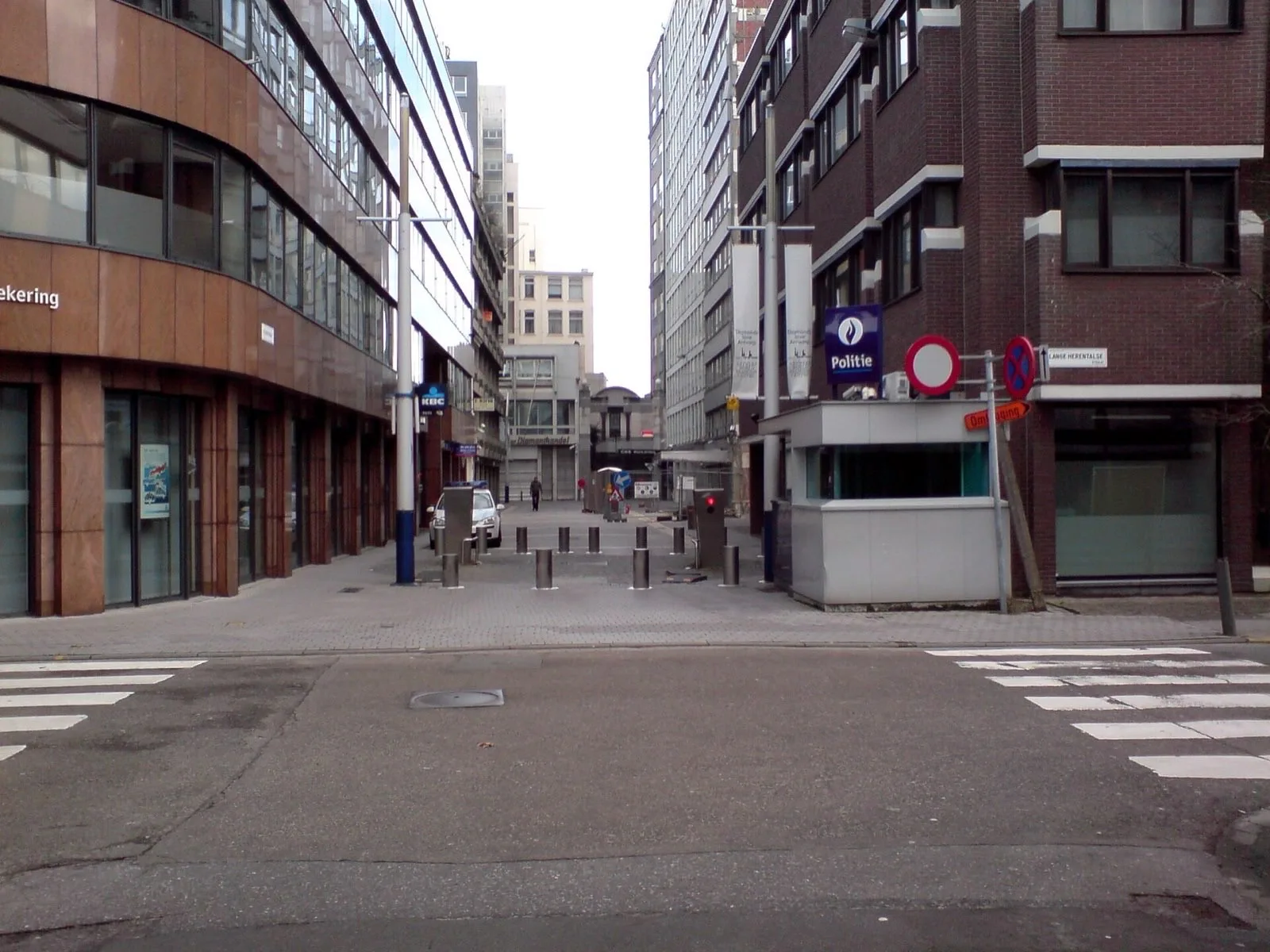
The vault beneath the Antwerp Diamond Center was one of the best protected in the diamond trade; Wired‘s 2009 account, which leans heavily on the gang leader’s own story, describes ten layers of security. On the night of 15 to 16 February 2003 a gang led by Leonardo Notarbartolo, an Italian who had rented an office in the building and posed as a gem dealer, got in anyway.11 By the time the case reached the appeal court, the reporting put the damage at 109 of the vault’s 189 safe deposit boxes forced.12
Police estimated the loss at $100 million; Notarbartolo has always claimed it was nearer $20 million and hinted at an insurance fraud. The loot was never found.11
What undid the gang was rubbish. On the Monday morning a grocer found plastic bags dumped on his land in the woods beside the E19 at Machelen, saw diamond parcel slips and bundles of Indian rupees among them, and called the police. The bags held business documents and a torn card bearing the name of an accomplice, Elio D’Onorio. About a week later the Diamond Center’s porter recognised Notarbartolo in Antwerp, and he was arrested. DNA from two more of the gang turned up in the flat where the loot had been shared out and at the dump site.12 In May 2005 the Antwerp court of appeal gave Notarbartolo ten years as the gang’s leader and three accomplices five years each.13 The famous salami sandwich comes from the retellings; the court reporting we could read doesn’t mention it. We set the court’s findings against Notarbartolo’s own story in our full account of the Antwerp diamond heist.
The Banco Central in Fortaleza, Brazil, 2005
This is one of the few successful attacks on a central bank vault. A gang rented a house near the Banco Central branch in Fortaleza and ran it as a front, a synthetic grass business, while they dug a tunnel to the vault. Reports give its length as 75 to 80 metres.1415 From the night of Friday 5 August 2005 they carried out R$164,755,150 in used R$50 notes, about three and a half tonnes of paper. That’s a lot to move through a tunnel. The theft was discovered when staff opened the vault on Monday 8 August.14
An earlier version of this article said most of the money was recovered. It wasn’t. In 2020 the Banco Central said it had recovered R$24.9 million, about 15% of the total.16 O POVO put the total recovered by 2025, including seized assets, at around R$60 million.14 Dozens of people were convicted, but more than half of the money is still missing.
Harry Winston, Paris, 2007 and 2008
Harry Winston’s Paris shop was robbed twice. In October 2007 four gunmen dressed as decorators forced the manager to switch off the alarms and open the safes, taking jewellery and watches worth over €32 million. In December 2008 four men came back, three of them in women’s clothes and wigs, and in under 20 minutes took 104 watches and 297 pieces of jewellery worth €71 million.17 (Early reports put the 2008 figure at up to €85 million.)
Both raids had help from inside: a former security guard let the robbers in. In February 2015 a Paris court sentenced eight men to terms of nine months to 15 years, the longest for the alleged organiser, Douadi Yahiaoui. Nearly 500 pieces were never recovered.17

What these cases say about vaults
Weak points
Around the door
Laguna Niguel’s gang came through the roof, Fortaleza’s through a tunnel. Burglars at a Cornhill jeweller’s did the same through a floor in 1865.18 A thick door is only as good as the walls around it.
The 1865 Cornhill robbery, in which thieves wedged open a Milner safe, changed British safe design for decades, a story told in our history of safe-cracking. For the vaults that have never been robbed, see the most secure vaults in the world, including the Bank of Spain’s flood-trap vault.
Myths and corrections
DNA from a sandwich convicted the Antwerp thieves.
The court reporting names dumped documents, a torn name card, DNA in a flat and in the woods, and a porter who recognised Notarbartolo. It doesn’t mention a sandwich.12
Viccei was caught by a fingerprint on a rental car.
The fingerprint was found at the Knightsbridge scene; he was arrested at the wheel of his own Ferrari.
Most of the Fortaleza money was recovered.
The Banco Central recovered about 15% by 2020; most of the R$164.7 million is still missing.
Antwerp’s thieves emptied 123 of 160 boxes.
Those were the first reports. By the 2006 appeal ruling the figures were 109 boxes forced out of 189.12
Frequently asked questions
Who was Amil Dinsio?
A bank burglar from Youngstown, Ohio, who led the 1972 break-in at United California Bank in Laguna Niguel. He was caught, of all things, through fingerprints on dirty dishes, and sentenced to 20 years.
What was the biggest bank robbery that went wrong?
Of the truly foiled raids here, the largest targets were the Millennium Dome diamonds, valued at £200 million, and the Heathrow gold and cash, put at up to £80 million.
Was the Knightsbridge robbery money ever recovered?
Only in part. The Guardian reported that about £10 million was recovered out of a haul estimated at £40 to £60 million.
Did Stockholm syndrome come from a bank robbery?
Yes. The term was coined after the six-day hostage siege at the Kreditbanken on Norrmalmstorg, Stockholm, in August 1973.
How were the Antwerp diamond thieves caught?
Through bags of rubbish dumped beside the E19 motorway, which held business documents and a torn card with an accomplice’s name, a porter who recognised Leonardo Notarbartolo in Antwerp, and DNA found in the flat where the loot was shared out.
Sources:
- BBC News Magazine, “What is Stockholm syndrome?” (21 August 2013). ↩︎
- Gemological Institute of America, “An Important Exhibition of Seven Rare Gem Diamonds”, Gems & Gemology, Summer 2003 (PDF). ↩︎
- AFP via Dawn, report on the Dome raiders’ sentencing (19 February 2002). ↩︎
- QEB Hollis Whiteman, R v Cockram & others; R v Wenham & others (2002), case summary and timeline. ↩︎
- BBC News, “Flying Squad foils £80m robbery” (18 May 2004), including the panel “World’s biggest robberies” (source: Guinness World Records). ↩︎
- Keith Sharon, “Bang for the Bucks”, Orange County Register serial in ten chapters, based on FBI and court documents (archived copy, 2008); chapters 3–5 and 8–9 cover the burglary, the dishwasher fingerprints, the sentences and recovery. ↩︎
- Larry Welborn, “Day 12: The largest bank heist in U.S. history targets Nixon’s millions”, Orange County Register (13 November 2009). ↩︎
- The Film Stage, review of Finding Steve McQueen (12 March 2019). ↩︎
- The Guardian, “Wolf’s last stand” (20 April 2000). ↩︎
- Open Library, Valerio Viccei, Knightsbridge (Blake Publishing, 1992); Tim Coates’s only related title is The Great British Train Robbery, 1963 (2003). ↩︎
- Joshua Davis, “The Untold Story of the World’s Biggest Diamond Heist”, Wired 17.04 (12 March 2009). ↩︎
- Jan Heuvelmans, “Het blijft vijf jaar cel voor D’Onorio en Finotto”, Het Nieuwsblad (17 March 2006), report of the Antwerp court of appeal ruling of 16 March 2006 (in Dutch; archived copy). ↩︎
- La Dernière Heure, “De 5 à 10 ans pour le casse du siècle à Anvers” (19 May 2005), report of the Antwerp court of appeal judgment (in French; archived copy). ↩︎
- O POVO, “Furto ao Banco Central: 20 anos depois, a poeira do túnel ainda paira no ar” (5 August 2025). ↩︎
- Exame, “Participante do furto ao BC em Fortaleza volta a ser preso” (29 March 2017). ↩︎
- O POVO, “Do que a quadrilha levou, Banco Central conseguiu recuperar R$ 24,9 milhões” (7 August 2020). ↩︎
- AFP via The Peninsula, “Eight jailed in 100m euro double Paris jewellery heist” (28 February 2015). ↩︎
- George Hayter Chubb, Protection from Fire and Thieves (1875), chapter “The art of burglary”, via Project Gutenberg. ↩︎
The History of Safes letter
One old safe a month, in your inbox
Once a month I send one safe worth a closer look, the new maker histories and a find from the patent and advert collection. Nothing else, and you can leave with one click.
You'll get a confirmation email first. One email a month, unsubscribe any time. Privacy policy.


